Tribe: A Foodie Community on Swiggy
Designing the MVP feature set and the exact, step-by-step UX flow for a foodie community feature on Swiggy
Frameworks: persona-led problem framing, MVP feature scoping
01 / the brief
You, as a PM, have to build a community of foodies on Swiggy.
- What will the MVP look like? (Exact features, not generic ideas.)
- What's the exact UX flow? (Step-by-step: where do users start, what do they see, where do they click, how do they come back?)
To make sure you know exactly what my thinking process is, I've left this document as unedited as possible. I've tried to fix grammatical errors, but I haven't changed the ordering of any point, so the thought process stays intact.
02 / personas
Five personas, built around the different reasons someone would open a food community.
Professionals · 23–30
Busy work life, no time to cook. This group relies on delivery for food intake.
College Students
They want to eat good food, but are also on a budget.
Family
Either want to find good places to eat outside, or look at bulk ordering for monthly groceries — think Zepto, BlinkIt, Swiggy Instamart.
Food Critiques
Find out new restaurants and cuisines to try out.
HRs / Community Leaders
Find places to host events and gatherings — ideally looking at catering services and/or bulk ordering of food.
03 / problem space
High delivery costs.
Inaccuracy of orders that leads to dissatisfaction, and inadequate customer support on top of it.
No reviews on restaurant food items to understand if a delicacy is actually good at that establishment.
No food community present as of now, where food influencers can come together. The closest thing is Instagram, plus offline events like Zomaland or Food Grub.
04 / risks
Opening any community up to the general public comes with predictable risks. Better to plan for them now than patch them later.
Trolling and harassment
Opening a community to general people invites trolling, bullying and harsh or offensive words within minutes.
Potential fix: Place strong protocols using moderation models to ensure user safety.
Misuse of location-tagged media
This one's a little over the top, but sharing videos and pictures of big, famous restaurants can fall into the wrong hands: the Mumbai Taj attack, at a scale nowhere near that severe, is the extreme version of this risk.
Potential fix: Restaurants can flag images or videos they don't want appearing publicly; if the request is legitimate, remove them from the post.
Dietary sensitivity
Certain vegetarians and vegans are very averse to the idea of anything non-vegetarian.
Potential fix: A veg filter for exactly that group.
05 / features
Interactive feed
Users upload images of food they’ve ordered, with comments. To organically drive Swiggy Dineout usage, the initial rollout only lets people who booked the restaurant through Dineout post about it opening up to everyone once the community has legs.
Recipe sharing, with the ability to link ingredients directly to Swiggy Instamart.
Polls and challenges: timed activities like “Where’s the best biryani in Hyderabad?”, where people vote and submit pictures with the restaurant’s location.
Restaurant-specific threads
A Q&A section where users or restaurants answer queries.
A crowdsourced “Must Try” dish section. Users can also rate specific dishes they’ve tried, with average stars shown, this works even better folded into the main Swiggy app.
Gamification
Badges and achievements: milestones like an “Amateur Critique” badge for 15 reviews logged, or a “Sweetest Tooth” badge for regularly interacting with dessert posts.
Monthly leaderboards: highly interactive users (posts, polls, answers, recipes) earn Swiggy Supercoins, redeemable for small discounts and promotions at specific restaurants, or even a free month of membership.
Challenges: a challenge of the month for the whole community. “Juicy June” encourages sharing recipes that boost liquid intake over summer; “Dash December” is about quick, easy food for people who don’t want to leave their bed in winter.
“Flavor Finale”
A Spotify Wrapped, but for Swiggy users.
Note: do NOT show total money spent. It will definitely decrease customer orders.
06 / ux flow
How Tribe fits into Swiggy
There are two obvious ways to tackle this: a standalone application, or folding the new features into the existing app. Opening Swiggy made it clear the latter is the better approach, Food Delivery, Instamart, Dineout and Genie already live as divisions of the same platform, so a community feature belongs there too.
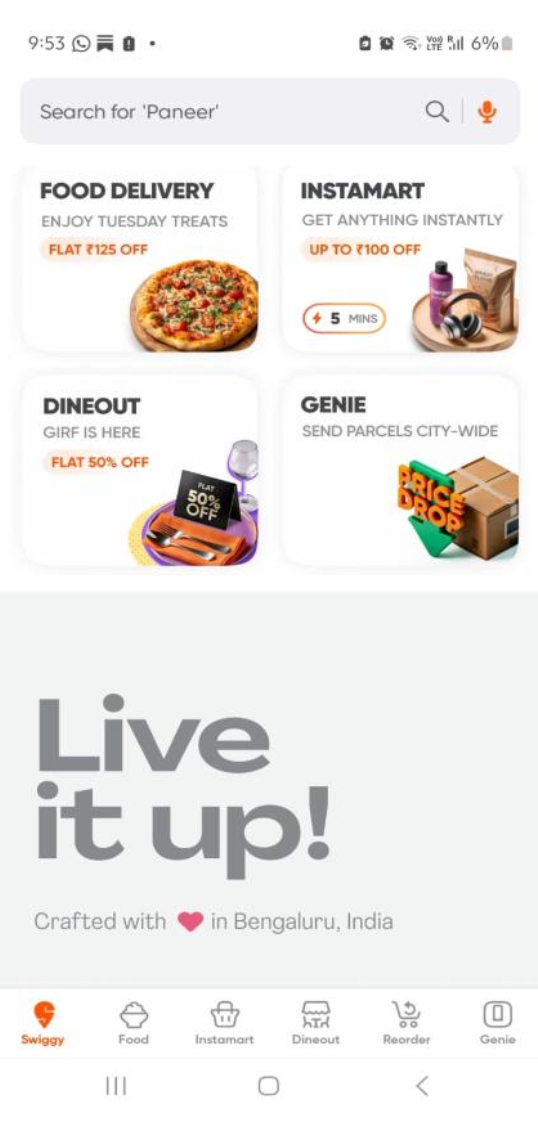
Swiggy application home
For this assignment I’m taking complete creative control of the application, and assuming all the ideas and flows presented sit down well in the existing ecosystem.
Instead of “Reorder”, the home screen gets a new entry point: “Tribe”.
Tapping Tribe opens a carousel-style feed - reviews from restaurants nearby, or recipes from food bloggers the user follows.
Tribe’s own nav bar has three tabs: Search — people and restaurants (a user’s own page shows their posts, ratings and polls; a restaurant’s page splits into posts, a searchable delicacy rating list, and Q&A, with the crowdsourced “Must Try” dish sitting right under the restaurant’s name), Home — the carousel feed, and Challenge of the month — the current community challenge, plus any others the user has opted into.
Badges and achievements show up on the user’s profile in the main app, visible to anyone who opens that profile, not just the user themselves.
UX flow diagram
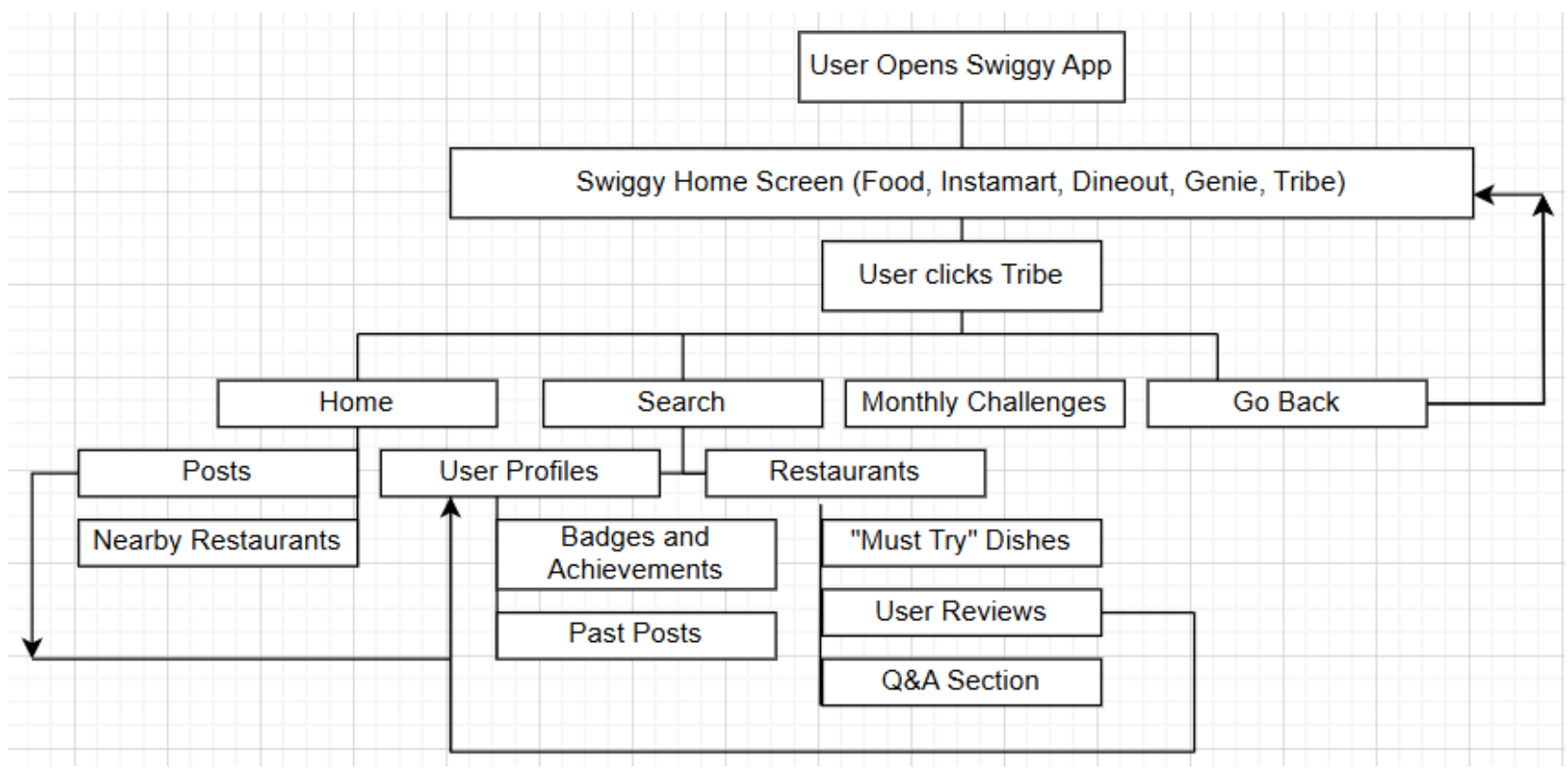
UX flow for Tribe